Detect and Mitigate Identity Fraud Risk Before Account Creation

New account creation is one of the riskiest stages in the digital customer journey, with 9.7% of applicants suspected to be fraudulent, according to the TransUnion H1 2026 Update: Top Fraud Trends Report. Cybercriminals are taking matters into their own hands by opening accounts they control — using either stolen identities, synthetic identities or even true identities with the intent to defraud. New account fraud losses amounted to roughly $6.2 billion in the US in 2024, consisting of various types of first-party frauds (e.g., credit abuse, deposit fraud, promotion fraud and more), according to Javelin Research. With only fragmented views of identities, it’s nearly impossible for organizations to effectively separate legitimate consumers from malicious ones — particularly at the “front door.”
What can organizations do to better protect their consumers and business at account creation?
Uncover identity fraud before fraudulent accounts are created
Separate genuine from risky users at new account creation to improve customer experiences, mitigate regulatory identity risks and increase conversions.
Link identities to devices
Flag risky devices being used to open accounts, uncover mismatches between identities and device usage, and assess online activities for associations to fraudster-controlled devices.
Improve customer conversions
Enhance consumer experiences while increasing passthrough rates for legitimate new applicants while applying the appropriate level of friction for risky applicants.
Fight first-party and synthetic identity fraud
Leverage consumer credit profile data along with extensive identity intelligence to better detect malicious intent or credit abuse.
Defend against automated identity attacks
Leverage a combination of identity attributes and device signals to triage non-human activity that fraudulently opens large volumes of fake accounts.
Combining identity with device signals to supercharge identity proofing
TruValidate™ new account fraud solutions unify all of TransUnion’s diverse data assets into an identity graph that includes online, offline, browsing footprint, phone network and device identity data. It enhances our solutions and models, enabling better fraud detection capabilities throughout the entire customer journey and across any channel — all delivered via a single application programming interface (API).
Uncover identity fraud before fake accounts are created
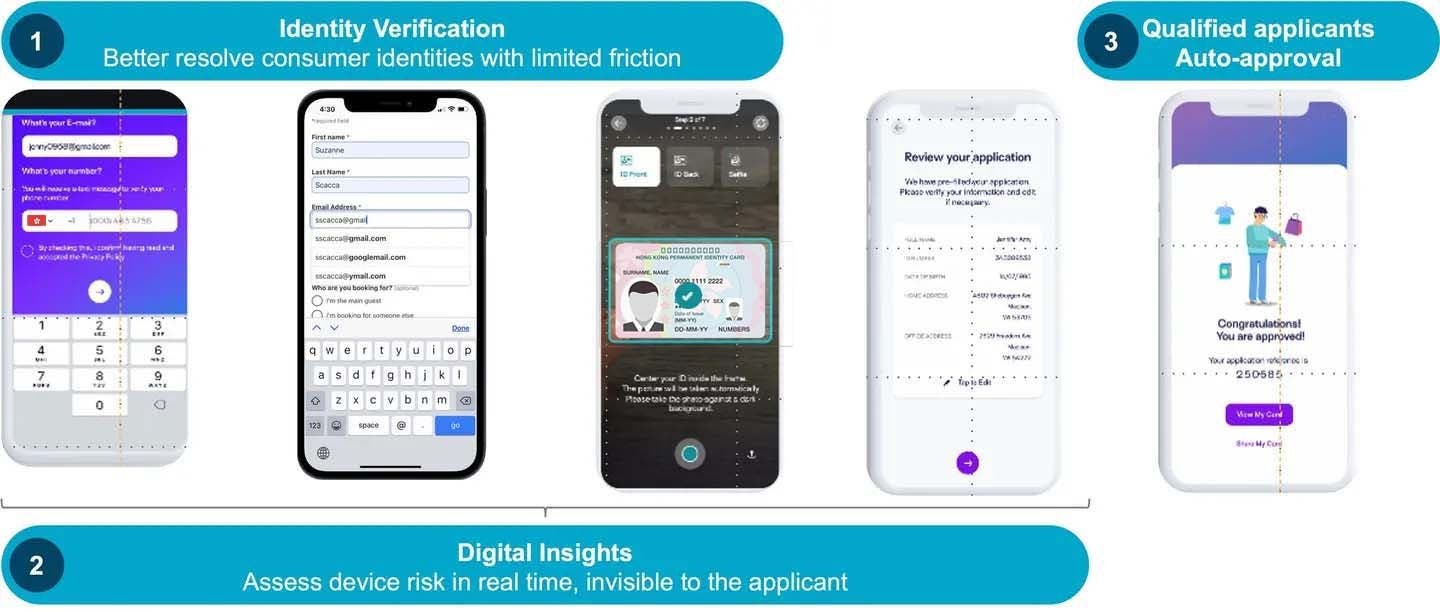
Identity Verification
Combine extensive consumer data (including credit, non-credit, public and device data) with cross-industry fraud analytics to match consumer-provided information against extensive datasets.
- Better verify and resolve consumer identities with higher match rates
- Design different fraud responses based on fraud threat – the use of stolen identities (third-party fraud) vs. true identities with malicious intent (first-party fraud)
- Help prevent account creations that use synthetic identities
KEY FEATURES:
- Distinct identity risk model scores with reason codes
- Fraud alerts targeting evolving fraud schemes
- Diverse and authoritative datasets
Digital Insights
The unique layering of complementary risk signals that provide expansive digital coverage. Includes device recognition with configurable device intelligence, machine learning (ML) models, and device-to-account linkages that assesses the strength of the linkage between the user and the device.
- Understand risks associated with anonymous digital interactions
- Track and uncover hidden fraud patterns
- Improve customer conversion
KEY FEATURES:
- Advanced device recognition, contextual analysis and behavioral insights helps distinguish fraudsters from real customers
- Device reputation and intelligence with fraud feedback based on longest standing and largest device risk consortium
- ML-based global device risk models help improve fraud capture and reduce false positives
- Data science-led risk strategy optimization service for increased performance of device risk rules
How TruValidate new account fraud works
Detect and mitigate identity fraud before account creation
Benefits of TruValidate new account fraud solutions
- Uncover identity fraud instances earlier: Fight first-party and synthetic identity fraud, detect anomalies and connect risky attributes by combining identity and device signals, helping detect risky users and transactions before fraudulent accounts are created.
- Unified API enables faster time to market: Streamline connection points to a single API — reducing demand on development, compliance and InfoSec resources — to swiftly deploy into production.
- Unified view of consumer risk profiles: Sharing of consumer data attributes from different customer journey points helps enhance identity resolution and fraud capture performance.
- Enhanced performance and efficacy: Combine identity and device signals to improve fraud capture rates and minimize false positives.
- Improve customer conversions: Separate genuine from risky users to determine the right level of friction to apply.
- Defend against automated identity attacks: Detect volume spikes, unusual activities (such as an IP mismatch) or anomalies on a device that may indicate automated attacks.
- Access to future innovations: TruValidate provides the foundation to more quickly integrate future capabilities from TransUnion’s global Innovation Labs.